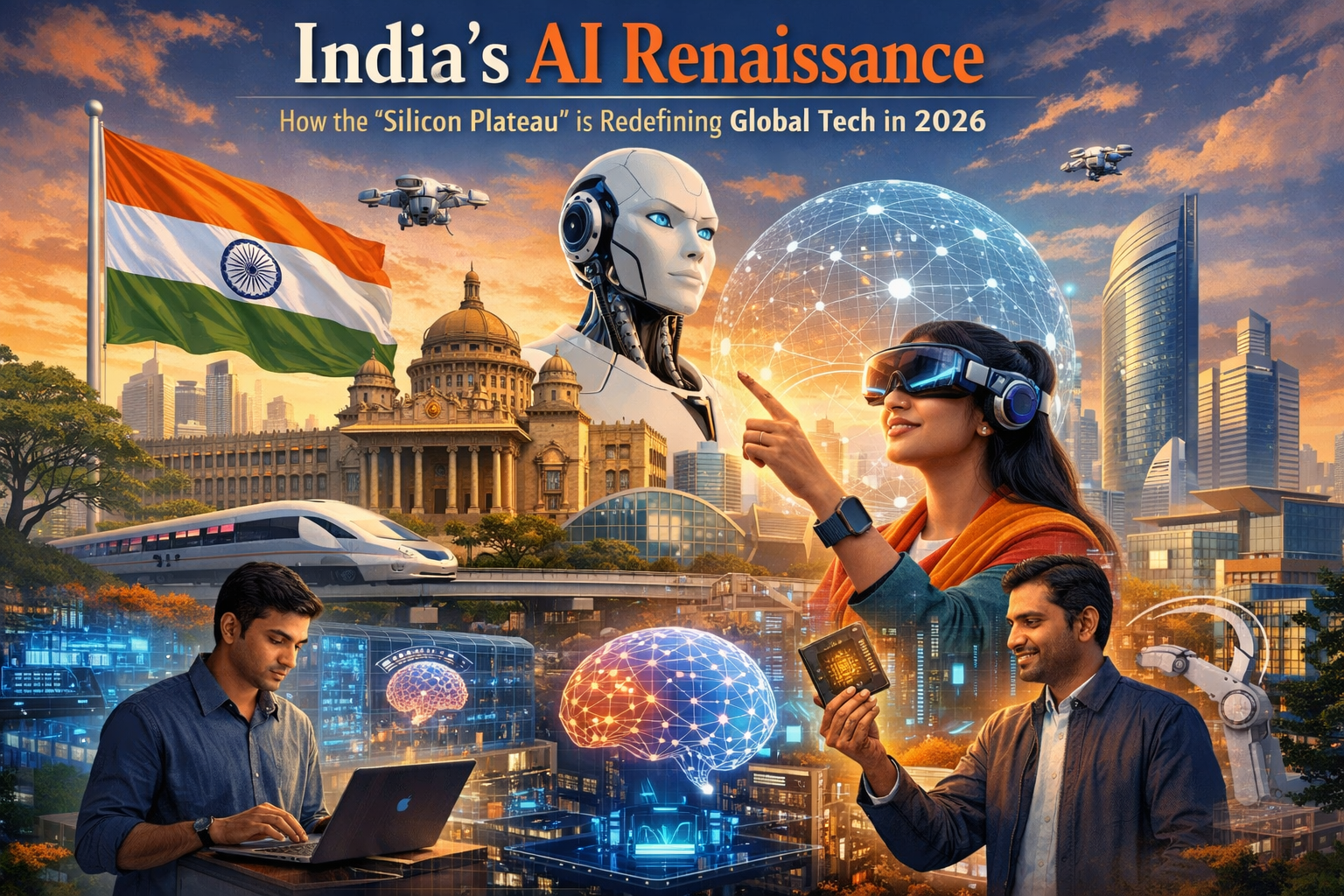
For decades, India was known as the world’s “back office.” But as we move into 2026, that narrative has shifted dramatically. Today, India is no longer just maintaining global systems; it is the laboratory where the world’s most ambitious AI solutions are being built, tested, and scaled.
From the villages of Uttar Pradesh to the high-rises of Bengaluru, Artificial Intelligence has moved from a boardroom buzzword to a national engine of growth. Here is why 2026 is being hailed as the year of the Indian AI Renaissance.
1. The "AI for All" Vision (IndiaAI Mission)

The Indian government’s approach to AI is unique. Rather than focusing solely on corporate profits, the IndiaAI Mission (backed by an outlay of over ₹10,300 crore) focuses on democratizing technology.
Sovereign AI: India is building its own foundational models trained on non-English, local datasets. This ensures that AI understands the cultural and linguistic nuances of 1.4 billion people.
The GPU Revolution: To fuel startups, the government has deployed over 38,000 GPUs, offering high-end computing power at subsidized rates (as low as ₹65 per hour) to ensure that even a student in a Tier-3 city can build a world-class model.
2. Breaking the Language Barrier with Bhashini

Perhaps the most transformative project is Bhashini, India’s AI-led language translation platform. In a country with 22 official languages and hundreds of dialects, AI is finally making “digital inclusion” a reality.
Real-time Translation: Farmers can now access government schemes via voice commands in their native tongue.
Project Vaani: In collaboration with Google and the IISc, this initiative is mapping the speech patterns of every district in India, creating a massive, diverse open-source dataset that is the envy of global developers.
3. The Economic Boom: Beyond IT Services

The “Big Six” IT firms (TCS, Infosys, Wipro, etc.) have pivoted. In 2026, nearly 75% of new deal wins are AI-led. But the real excitement is in the startup ecosystem:
| Sector | AI Impact in 2026 |
| Agriculture | Predictive analytics for crop yields and AI-driven pest control. |
| Healthcare | AI diagnostic tools in “VijAIpatha” labs reaching rural clinics. |
| Education | Personalized learning paths for millions of students via the DIKSHA platform. |
| Finance | AI-driven credit scoring for the 490 million workers in the informal economy. |
4. The Challenges: Ethics and Employment
It isn’t all smooth sailing. As AI adoption accelerates, India faces a significant “skilling gap.” Reports suggest India will need 1 million AI professionals by the end of this year. While 43% of experts believe jobs will adapt rather than disappear, the transition is creating a period of uncertainty in the traditional job market.
Moreover, the government is currently navigating complex regulatory waters, proposing labels for AI-generated content to combat deepfakes while trying not to stifle the creative “creator economy.”
The Road Ahead
India has moved from “playing catch-up” to “setting the pace.” With the Global AI Impact Summit scheduled for February 2026 in New Delhi, the world is looking to India to lead the “Global South” in responsible, inclusive, and scalable AI.
“India’s scale is its greatest strength. If an AI solution works in the diversity of India, it can work anywhere in the world.”