
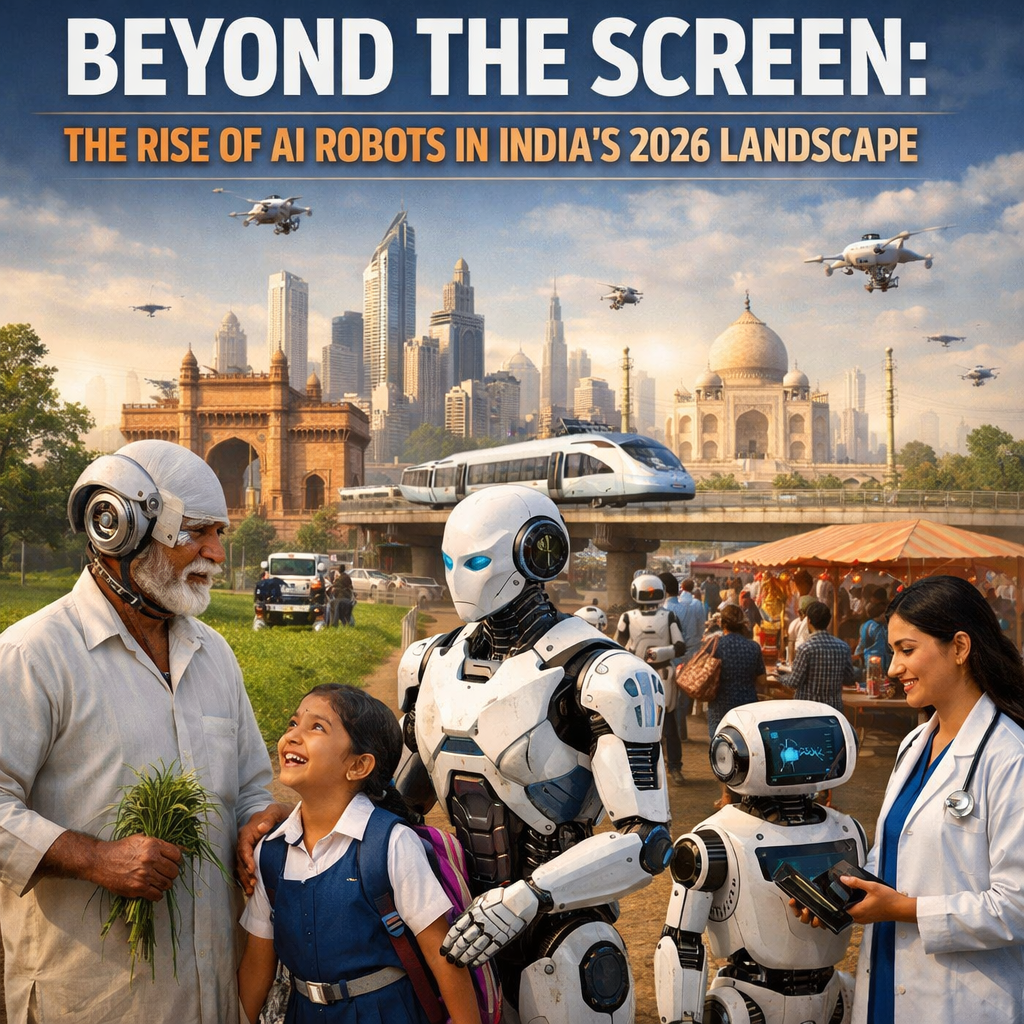
For years, “AI in India” meant software—code written in Bengaluru for companies in California. But as we step into 2026, the intelligence is finally getting a body. We are witnessing the birth of Physical AI, where India’s massive software expertise is merging with indigenous hardware to create robots that don’t just “think” but “do.”
From the sterile aisles of automated warehouses to the rugged terrains of rural farms, AI robots are no longer a futuristic curiosity; they are a national necessity.
1. The Domestic Humanoid Revolution

2026 is being called the year of the “New Roommate.” While the world watches Tesla’s Optimus, Indian startups like Miko and Asimov Robotics are making waves with robots tailored for Indian homes and schools.
Unlike early, clunky versions, today’s robots are powered by General Purpose Humanoid AI. They understand the “physics” of an Indian household—from navigating through tight spaces to handling delicate glassware.
Miko: Has evolved into an AI-powered educational companion sold in over 140 countries.
Chassis-based helpers: Are now being trialed in urban Indian apartments to manage chores like laundry and home security.
2. Solving Social Challenges: Robots for Good

India’s robotics story is unique because it often addresses deep-seated social issues. The most iconic example is Genrobotics’ “Bandicoot.”
In 2026, the deployment of sanitation robots has expanded across nearly 20 states, effectively replacing manual scavenging with technology. These AI-driven machines use computer vision to navigate sewers, proving that robotics can be a tool for human dignity, not just corporate efficiency.
3. The Industrial Backbone: Warehouses and "SSI Mantra"

While domestic robots get the headlines, the “boring” robots are doing the heavy lifting in India’s economy.
Logistics: Companies like Addverb and GreyOrange have turned Indian warehouses into “Sentient Hubs.” Thousands of Autonomous Mobile Robots (AMRs) now use real-time AI to coordinate deliveries for giants like Flipkart and Reliance.
Healthcare: The SSI Mantra, India’s first indigenous surgical robot, is now operational in several hospitals, including Apollo and AIIMS. It brings the precision of AI-assisted surgery to the masses at a fraction of the cost of international models.
4. Government Support: The IndiaAI Mission
The rapid growth of 2026 wouldn’t be possible without the IndiaAI Mission. With an outlay of over ₹10,300 crore, the government has created a “sovereign AI” ecosystem.
Compute Power: Startups now have access to over 38,000 GPUs to train their robotic brains.
Affordability: Through subsidies, the cost of developing AI models has plummeted, allowing small scale manufacturers to integrate “Cobots” (collaborative robots) into their factories.
| Sector | Key Robotics Player | Primary Function |
| Logistics | Addverb Technologies | Warehouse Automation (AMRs) |
| Healthcare | SS Innovation | Robotic-Assisted Surgery |
| Defense | Janyu Tech | Tactical Drones & Surveillance |
| Sanitation | Genrobotics | Sewer Cleaning & Exoskeletons |
5. The Path Ahead: From Labs to Streets
The next frontier for 2026 is the India AI Impact Summit in New Delhi, where the focus will shift to “Safe and Trusted AI.” As robots move from factories to public sidewalks, the conversation is moving toward ethical governance—ensuring that these machines remain “Human-Centric.”
The “Silicon Plateau” is no longer just a metaphor for software; it is now a bustling factory floor for the world’s most practical robots.